
| What lactic acid looks like under 400x magnification. (elfwood.com) |
For anyone who has been through a basic biology course, lactic acid is a familiar term. It's simply the byproduct of anaerobic (oxygen-free) cellular respiration. Cellular respiration occurs inside cells, and turns glucose and oxygen into energy (ATP) and carbon dioxide (and other stuff, but we're keeping it simple here).
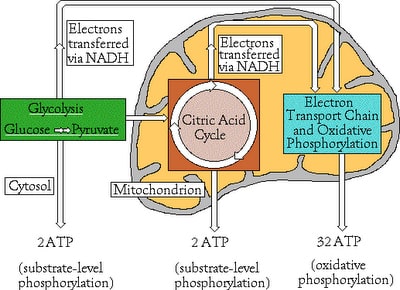
So when glucose gets sucked into a cell, it floats around initially in the cytosol, which is just the goop that takes up space inside a cell where there aren't any organelles. Then, the mitochondria get ahold of the glucose. Mitochondria are the cell's powerhouses; that is, they produce the energy your cells need to keep functioning, which in turn keeps you alive. Yay mitochondria!
Glucose by itself isn't very useful for the mitochondria, so it undergoes glycolysis. In biology, anytime you see the word "lysis" or "lyse," it means something just got ripped up. Glycolysis is when some sugar (glucose) gets ripped up. It turns into pyruvic acid, which the mitochondria then gobble up and turn into wonderful, useful ATP.
The above assumes that oxygen is present, since oxygen is what enables the Krebs Cycle (also called the Citric Acid Cycle) to occur. But what if there's no oxygen available? Well, kids, we have to get ATP somewhere, so we turn to anaerobic respiration! No mitochondria needed.
Anaerobic respiration happens in the cytosol, since we're not using mitochondria.
_files/image002.gif)
Since you and I are not yeast (at least, I hope you're not yeast), we do not undergo fermentation and end up with alcohol. Instead, we undergo fermentation and end up with lactic acid (which is less drinkable than alcohol).
I know what you're thinking. "Yeah that's great and all, but I don't get what it has to do with running a half marathon."
Running is an aerobic exercise. You need oxygen to do it. If you run too hard (or if you're not in good enough shape), you're unable to get enough oxygen to get that pyruvic acid into your mitochondria. So it turns into ATP in the cytosol. Magic!
But it doesn't only turn into ATP. The waste product is lactic acid, and this is where the silliness begins. In the early 1900s, some guy named Otto cut a frog in half and put its legs into a jar. He then administered shocks to the frog's legs, which caused the muscles to contract. However, the muscles would only contract a few times before they simply could not do so anymore. Why is that, you might ask? Well, Otto wondered the same thing. Only, instead of coming to conclusion that the frog is fucking dead, he determined that since there was a lot of lactic acid present on the muscles of the dead frog legs, it must mean that lactic acid causes muscles to not contract.
Or maybe, there was a lot of lactic acid because the cells in the frog's legs had no way of getting oxygen, which meant they were forced to undergo anaerobic respir--- whatever. Silly early 20th Century science.
Because of Otto's incorrect theory, athletes have been fed the line, "If you push too hard and get lactic acid buildup, you're going to pay for it with fatigue and super soreness!"
But then in the 1960s, some crazy college student who would later become some crazy doctor guy was running track for his crazy school. His crazy track coach gave him the speech about staying out of the "lactic acid zone," and the crazy college student said, "Uhh coach? That doesn't really make any sense." To which the coach replied, "How dare you question my authoritah?! I took two semesters of exercise physiology before I dropped out of college!"
Well crazy college student, who now goes by the name of Dr. Brooks, decided to choose the issue of lactic acid for his PhD dissertation. He injected rats with lactic acid and discovered that, not only were the rats decidedly neither fatigued nor super sore, they were actually burning the lactic acid as fuel.
Yes. In the absence of oxygen, pyruvic acid is turned into small amounts of ATP and lactic acid. Then, the lactic acid is taken into the mitochondria and used as fuel. In fact, Dr. Brooks discovered that mitochondria have a special transport protein in their membrane that is there for the sole purpose of bringing lactic acid inside.
If there is any lactic acid that doesn't get sucked into the mitochondria, it doesn't just hang around. It gets cleaned up and metabolized by other organelles in your cell, because if there's one thing your cells hate, it's loitering proteins. This cleanup of lactic acid takes less than an hour.
So what does make muscles sore? It's simple, and something that everyone who has ever tried to bulk up already knows. Every time you work your muscles out, they tear and rebuild. Tearing hurts. So your muscles get sore. Then after they rebuild, they're not sore anymore, and they're bigger and better and more efficient. So if you work out hard enough to get sore, you're working out hard enough to improve your muscles. So keep it up! Just don't overdo it. Soreness is one thing; pain is another.

No comments:
Post a Comment
I <3 Comments