Showing posts with label SciFriday. Show all posts

Friday, May 20, 2011

SciFriday

If the movie "Finding Nemo" had been based on reality, it would have been way different.


We all know that Great White Sharks don't hang out with Hammerheads and form Fishaholics Anonymous meetings in sunken WWII submarines. We all know that fish can't read. We all know that a clownfish would last about 10 minutes if it ventured away from a reef - not purely because of predation, but also temperature. The scene where Marlin and Dory dive into that chasm? They would have frozen to death or been crushed by the pressure before finding that mask.

We all know that stuff above, but we don't care. It's a Disney movie. Talking pelicans? Sure! They're entertaining! We expect talking empathetic animals in Disney movies. In fact, a Disney movie without talking animals or inanimate objects is bullshit. So what's my beef with Finding Nemo?

Clownfish.

At the beginning of the movie, we are soothed by a tranquil scene of a big pink sea anemone perched on the edge of a reef. Two clownfish are hanging out in this anemone.
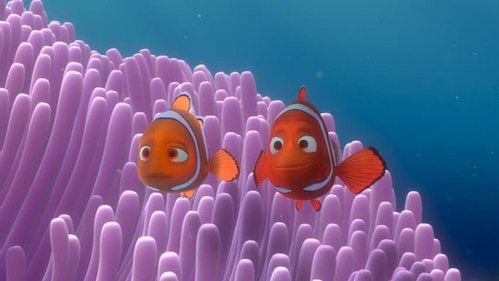
Coral and Marlin

Presumably, Marlin is the daddy, and Coral is the mommy. They have a big bunch of eggs hidden in a little cave below the sea anemone. When asked about what to name their babies, Marlin replies, "We'll call this half Marlin Jr, and this half Coral Jr."

No you won't, Marlin. There will be no Coral Jrs. All of your babies are going to be boys.

All clownfish are born male. 100%. There are no baby girl clownfish. Sorry. In fact, most clownfish are male. Generally, the only female clownfish are the ones that are in charge of their anemone.

It's depicted in popular culture that an anemone is a house for one clownfish, or a little family of clownfish. This isn't exactly true. Depending upon the size of an anemone, it can house several clownfish. A group of clownfish living on a single anemone is kind of like a pack of wolves: there are a bunch of underlings, and one breeding alpha pair. But unlike wolves, the critter in charge of a clownfish group is a big bitchy female.

With Marlin and Coral, Coral would have been the fish in charge. She would have been bigger than Marlin, and he would have been her bitch. They would have had several other male clownfish living with them, but they would have all been considered juveniles; that is, they wouldn't be eligible for mating. And they all would have bowed down every time Coral swam by.

SPOILER ALERT

Coral dies. She gets eaten by a barracuda. And apparently, the barracuda has figured out how to suck eggs out of a tiny cave, because the barracuda eats all but one of the eggs. So when Marlin wakes up (the barracuda punched him out), he discovers that he is all alone in the world, except for this one egg.

In reality, something like this could conceivably happen. If we want to be really accurate, we'll still say there are other males living on the anemone with Coral and Marlin. After Coral dies, the group of clownfish is leaderless. Also, it's a total sausage fest.

OK, so Coral is dead. Marlin and the other male clownfish are all like, "Oh shit! She's dead!" But they're not freaking out too much. And here's why: Marlin, being the highest-ranking male, is just going to turn into a female. It's gender reassignment surgery, only without the surgery. He's just going to spontaneously grow a vagina.

So now Marlin is Marlinette. He's all sexy and womanly and he needs a mate. One of the lower-ranking males will step up to the challenge, grow some balls (literally), and become the new mating male.

So in Finding Nemo, Marlin(ette) wouldn't be a single parent. He would be a mommy, and while Nemo's real mommy would be dead, he would still have a daddy. Two daddies. Two mommies? Now I'm confused.

Oh yeah, and by the time Nemo was old enough to go to fish school, Marlinette would have kicked his freeloading gimpy ass to the curb. Since all of the males in the anemone are potentially mates for Marlinette, she wouldn't want one of her own offspring sticking around. Inbreeding is gross.

Paddle faster!

Friday, May 6, 2011

SciFriday

Jake and I are about to start training for a half marathon that will kill me take place in September. I've been on the Google Machine, looking up different marathon training strategies, and I keep coming across the dreaded lactic acid.

What lactic acid looks like under
400x magnification.
(elfwood.com)

Friday, April 29, 2011

SciFriday

It's time for the first installation of SciFriday!

So, have you ever stubbed your toe or slammed your finger with a hammer, and while you're grunting and swearing, you grab onto your injured body part and squeeze it? You probably have. I think everyone has, or at least they've wanted to.

Squeezing an injured body part seems counterproductive. It seems like it would just make it hurt more.

However, squeezing (or putting pressure on) an injured body part actually makes it hurt less. This phenomenon is due to something called the gate-control theory of pain.

You've probably never wondered exactly how you feel things. Someone punches you in the face, and it hurts, right? Right. But what if, instead of punching you, someone simply strokes your face instead? Or pours cold water onto it? Or blows onto it? How do you know the difference? Or more importantly, how does your brain know the difference?

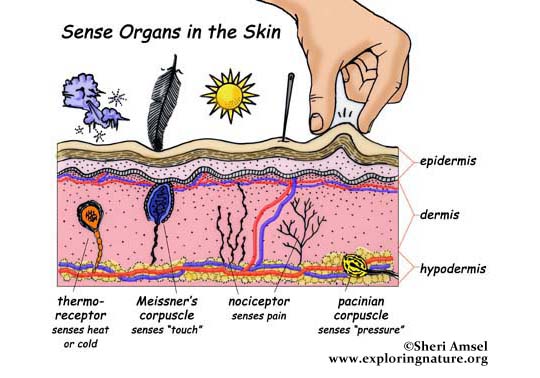
Well, under your skin, you have a metric ass ton of cells called sensory receptors, which are basically just specialized neurons.

picture from exploringnature.org
Sensory receptors aren't only present in skin; they're responsible for vision, hearing, blood pressure regulation, and about a zillion other things. If you didn't have these receptors, not only would you be blind, deaf, and unable to feel anything, your blood pressure would careen out of control and your blood's pH would fall or climb to much that you would die.

Take a gander at the picture up there (which is an awesome picture, might I add). If someone dumped cold water in your face, you'd know that it was cold because of thermoreceptors. If the water was between 35 and 20 degrees Celsius, the cold receptors in your skin would start pinging, sending messages to your brain that it's fuckin' cold send more blood! Strangely, temperatures above 45 degrees Celsius (113 Fahrenheit) also make cold receptors ping, which makes you feel cold even when the stimulus is painfully hot.

So, we were talking about being punched in the face. When you are punched in the face, nociceptors are activated. Nociceptors have many jobs, one of which is to feel pain so that you can get away from it. They also activate autonomic responses, like an increase in blood pressure, heart rate, epinephrine, sweating, and other fun stuff (all of which play a role in allowing you to escape the cause of your pain, like a dinosaur). Nociceptor activation will also make you angry or scared. So if you get punched in the face and your heart starts thumping and you want to punch back, it's because those nociceptors that were activated during the punching have gone and woken up the caveman part of your brain.

You get punched. If we imagine that whoever punched you has no interest in escalating further, you are now left to stand there and whimper. Your first instinct (besides to retaliate) is to put your hand up to the tender spot. Your higher brain says "No don't touch it! It's sore and going to hurt more!" But your lizard brain just wants you to rub that sore spot as hard as you can.

Why, lizard brain, why?!

Because of the gate-control theory. That's Dr. Lizard Brain to you.

www.d.umn.edu

This is an illustration of the gate-control theory. On the left is unmodulated pain, or what happens when you don't press on your owies. Basically, all that is illustrating is that each nociceptor has an inhibitory interneuron - a neuron that would decrease the pain if only the nociceptor would let it. But the nociceptor's job isn't to not let you feel pain; the nociceptor needs you to know that something bad is happening so that you can get away from it and prevent injury! So the nociceptor has a built-in inhibiter of the inhibitory interneuron which disables the inhibitory interneuron, which allows the full pain signal to reach your brain.

Enter modulation! When you rub your skin after being punched, you're essentially telling your nociceptors "Yeah yeah I know, I got punched." Rubbing activates the A-beta fibers you see in purple in the illustration, and those fibers un-inhibit the inhibition of the inhibitory inte--- OK, those A-beta fibers make the inhibitory interneurons work, which then sends a modulated (read: weaker) pain signal to your brain.

The result: less pain! So the next time you get punched in the face, don't fight that urge to rub your owie.

Tuesday, April 26, 2011

Eureka!

So, I wrote a post about wanting to do a weekly thing, I just didn't know exactly what. But today while I was driving home from school, gleeful from learning all about gamma radiation, that I had one of those "a-ha!" moments.