
So, have you ever stubbed your toe or slammed your finger with a hammer, and while you're grunting and swearing, you grab onto your injured body part and squeeze it? You probably have. I think everyone has, or at least they've wanted to.
Squeezing an injured body part seems counterproductive. It seems like it would just make it hurt more.
However, squeezing (or putting pressure on) an injured body part actually makes it hurt less. This phenomenon is due to something called the gate-control theory of pain.
You've probably never wondered exactly how you feel things. Someone punches you in the face, and it hurts, right? Right. But what if, instead of punching you, someone simply strokes your face instead? Or pours cold water onto it? Or blows onto it? How do you know the difference? Or more importantly, how does your brain know the difference?
Well, under your skin, you have a metric ass ton of cells called sensory receptors, which are basically just specialized neurons.
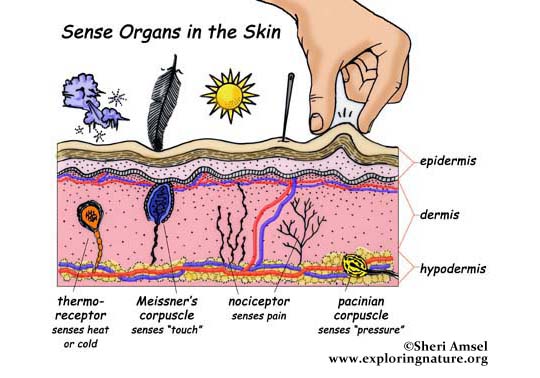 |
| picture from exploringnature.org |
Take a gander at the picture up there (which is an awesome picture, might I add). If someone dumped cold water in your face, you'd know that it was cold because of thermoreceptors. If the water was between 35 and 20 degrees Celsius, the cold receptors in your skin would start pinging, sending messages to your brain that it's fuckin' cold send more blood! Strangely, temperatures above 45 degrees Celsius (113 Fahrenheit) also make cold receptors ping, which makes you feel cold even when the stimulus is painfully hot.
So, we were talking about being punched in the face. When you are punched in the face, nociceptors are activated. Nociceptors have many jobs, one of which is to feel pain so that you can get away from it. They also activate autonomic responses, like an increase in blood pressure, heart rate, epinephrine, sweating, and other fun stuff (all of which play a role in allowing you to escape the cause of your pain, like a dinosaur). Nociceptor activation will also make you angry or scared. So if you get punched in the face and your heart starts thumping and you want to punch back, it's because those nociceptors that were activated during the punching have gone and woken up the caveman part of your brain.
You get punched. If we imagine that whoever punched you has no interest in escalating further, you are now left to stand there and whimper. Your first instinct (besides to retaliate) is to put your hand up to the tender spot. Your higher brain says "No don't touch it! It's sore and going to hurt more!" But your lizard brain just wants you to rub that sore spot as hard as you can.
Why, lizard brain, why?!
Because of the gate-control theory. That's Dr. Lizard Brain to you.
 |
| www.d.umn.edu |
This is an illustration of the gate-control theory. On the left is unmodulated pain, or what happens when you don't press on your owies. Basically, all that is illustrating is that each nociceptor has an inhibitory interneuron - a neuron that would decrease the pain if only the nociceptor would let it. But the nociceptor's job isn't to not let you feel pain; the nociceptor needs you to know that something bad is happening so that you can get away from it and prevent injury! So the nociceptor has a built-in inhibiter of the inhibitory interneuron which disables the inhibitory interneuron, which allows the full pain signal to reach your brain.
Enter modulation! When you rub your skin after being punched, you're essentially telling your nociceptors "Yeah yeah I know, I got punched." Rubbing activates the A-beta fibers you see in purple in the illustration, and those fibers un-inhibit the inhibition of the inhibitory inte--- OK, those A-beta fibers make the inhibitory interneurons work, which then sends a modulated (read: weaker) pain signal to your brain.
The result: less pain! So the next time you get punched in the face, don't fight that urge to rub your owie.

No comments:
Post a Comment
I <3 Comments