
 |
| This kid thought the guy was saying "numbnut." |
This said, there is still no excuse to speak and write your native tongue like you're a developmentally-challenged 3rd-grader. (Obviously, this post doesn't apply to people who speak English as a second language. In fact, I'm impressed by your tenacity in sticking with our crazy language long enough to pick it up.) It really isn't that hard, people, especially with my handy-dandy "Idiot's Guide to English" that I'm about to lay out for you all.
Note: all of the definitions were looked up at www.dictionary.com. The example sentences came out of my own noodle and may or may not be inappropriate for young children, elderly citizens, or Catholics.
Here and Hear
Here, meaning "in this place." For example, "The Catholic priest touched me right here."
Hear, meaning "to perceive by the ear." For example, "Did you hear Miley Cyrus's new song? It made my ears bleed!"
Differentiating between here and hear is relatively easy. Hear has the word ear in it, and therefore should be easy to pinpoint as the one that involves ears.
Your and You're
Your, meaning "belonging to you." For example, "I've got my eye on your race-car bed."
You're, which is a contraction of the two words you and are. For example, "There is no way you're going to get my race-car bed."
You're is a contraction, so it's easy to differentiate between these two. If you are makes sense in the sentence, then go with you're. If it doesn't, go with your. The sentence "I've got my eye on your race-care bed" doesn't make any sense if it read, "I've got my eye on you are race-car bed," so clearly the correct choice is not you're.
There, Their, and They're
There, meaning "in that place." For example, "I think I see a yak over there by those Swedish tourists."
They're, which is a contraction of the two words they and are. For example, "They're teasing the yak. This does not bode well."
Their, meaning "belonging to them." For example, "Their Swedish guts are all over the place due to that yak-stomping."
There has here in it. Therefore, you can see that they're both location words. Keep this in mind when we discuss where, which also has here in it.
They're (and all contractions, really) is easy to figure out because you just break it up. In any case where saying "they are" would be appropriate, you fill it in with they're. The sentence "Do you think we should help the paramedics pick up they're Swedish body parts?" is incorrect, because if you split they're up in to they and are, that sentence makes no sense.
Their, being the final word in this group, can be figured out if you just eliminate the other two.
Where, Wear, Were and We're
Where, meaning "in or at what place?" For example, "Where is Waldo?"
Wear, meaning "to carry or have on the body." For example, "Waldo is the guy who wears the red and white shirt."
Were, which is the past tense of the word "are." For example, "We were looking for Waldo yesterday, but we didn't find his sneaky ass."
We're, which is a contraction of the two words we and are. For example, "We're going to pound Waldo's dorky face in when we find him."
Where, as I mentioned before, has here in it, and therefore is in the locational words group (here, there, where).
We're, as with all contractions, is discerned by breaking it up: we are. If that makes sense in the sentence, then you go with we're.
Wear and were are just going to have to be memorized, I'm afraid. The only way I have to remember these two is kind of weird, so it might work for you or it might not. Wear has ear in it, and you wear your ears on your head. Were is when you eliminate the other options.
Its and It's
Its, meaning "belonging to it." For example, "That squirrel buried its nuts under the tree."
It's, which is a contraction of the two words it and is. For example, "I stole the squirrel's nuts and now it's really pissed."
OK, nothing drives me more bananas than when people use apostrophes out of context, especially when they use apostrophes in pluralizing.
As with all contractions, it's can be identified as correct when you break it down. Does it is make sense? Then you use it's. If not, you use its.
Our and Are
Our, which is the possessive of we. For example, "That's our Justin Bieber CD."
Are, the plural present conjugation of the verb "to be." For example, "Are you seriously claiming ownership of a Justin Bieber CD?" or "Yes, we are seriously claiming ownership of a Justin Bieber CD."
To understand these two words, you need to understand the English conjugation grid for the irregular verb "to be."
I am stinky.
He/she/it is stinky.
We *are stinky.
They *are stinky.
And also possession:
My pony.
His/her/its pony.
*Our pony.
Their pony.
Two, Too, and To
Two, the number. Also written as 2. For example, "There are two delicious cupcakes in the kitchen."
To has many definitions, most of which indicate a movement toward something. For example, "I'm going to the kitchen and eating me a delicious cupcake."
Too, meaning "also." For example, "I'll go to the kitchen and eat a delicious cupcake, too."
To is the easy one. Most people confuse two and too.
Too becomes easy when you remember that it means "also." In the word too, it has one O and also another O.
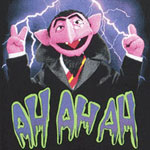
Two has a W (double-U) in it. In a double-U, there are two Us. Two. I feel like the Count. TWO! Ah! Ah! Ah!
Then and Than
Then, meaning "at that time." For example, "I pimp-slapped the ho, and then she gave me the money."
Than, which is used after comparative adjectives and adverbs to introduce the second member of unequal comparison. For example, "My ho earns more money than your ho does."
Then is a time-based word. It's almost the same as when (just substitute the T for a W). That should clue you in that then should be used when discussing time-based things.
Than is used in comparisons, which have nothing to do with time.
Shudder and Shutter
Shudder, meaning "to tremble with sudden convulsive movements." For example, "Thinking about Sarah Palin being elected President makes me shudder with horror."
Shutter, meaning "a solid our louvered movable cover for a window." For example, "If she gets elected, I'm going to shutter all my windows and move to Australia."
I don't really have a good way to remember this one, but I always see people say they're "shuttering with fear." No, you're not.
Flammable and Inflammable
Flammable, meaning "easily set on fire." For example, "If you roll in gasoline, you become extremely flammable."
Inflammable, meaning "easily set on fire." For example, "If you roll in gasoline, you become extremely inflammable."
That's right, folks, they're the same thing. Inflammable does not mean "not flammable." Now you know, so stop using it as such.
Ain't is a Word
I remember being a kid and singing the taunt, "ain't ain't a word and you ain't gonna say it!" Well, seven-year-old me, ain't is indeed a word, and I am going to say it.
Ain't is the contraction for the two words "am not." Think about it. If we follow conventional English contraction rules, "am not" would become "amn't." Try saying it. It's weird, huh?
For the phrase "I am not," most people will use the contraction, "I'm not" because saying "I amn't" is just ridiculous.
Enter ain't. It's easier to say than amn't, even if it is normally only used by the uneducated or in colloquial speech. It's rarely written except to make a character's dialect sound less educated or (according to dictionary.com) more Southern. I think dictionary.com is saying Southerners are stupid. I resent that!
So the next time you say "ain't" and someone gives you hell for it, simply explain that ain't is the contracted form of the phrase am not, and that you were simply engaging in colloquial speech. That ought to shut them right the fuck up.
So there you go. That's my crash course in common English misspelled words n' shit. The Oatmeal has many informative blog posts on various grammar issues, including how to use a semicolon, how to use apostrophes, when to use i.e., and common misspellings (many of which are the same as mine but he has a couple more than I forgot about, like weather and whether).

Every time someone says 'your welcome' Galactus eats a planet.
ReplyDeleteIs this post in response to my post about my lackadaisical spelling and editing skills?
ReplyDeleteHa no. It was inspired by a posting by a friend on FB who is apparently unfamiliar with how "two" and "too" are supposed to be used. :P
ReplyDelete